|
お花の短冊 ホタルの明かり
|
|
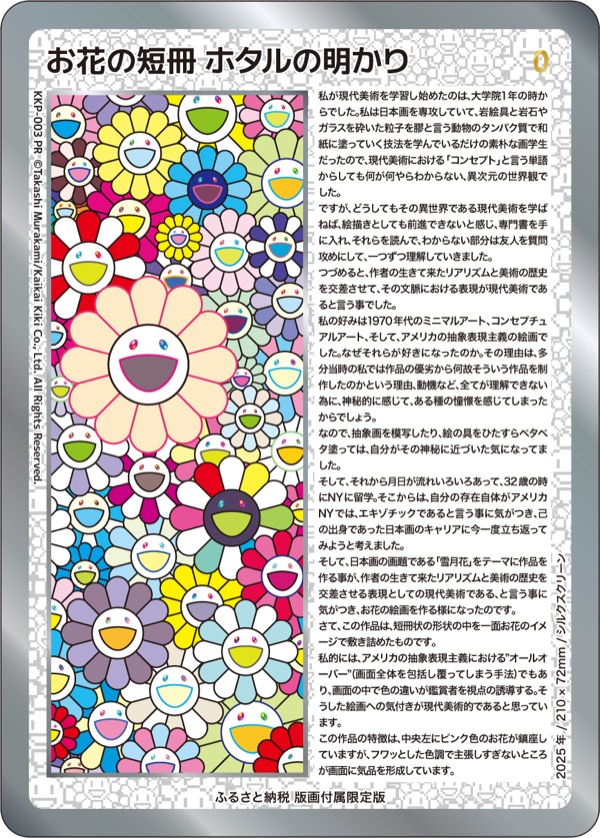
KKP-003 (PR) - I began studying contemporary art during my first year of graduate school. I was a naive art student majoring in Japanese-style painting, Nihonga, simply learning the technique of applying mineral color and crushed rock and glass particles on Japanese paper with nikawa, an animal protein glue. I had no clue what the word "concept” meant in contemporary art, even; it had an entirely different worldview.
I felt, however, that if I didn't learn about this other world that is contemporary art, I wouldn't be able to advance as a painter. So I obtained specialized books, read them, and asked my friends questions about the parts I didn't understand, making sense of things one by one.
What I understood, in short, was that contemporary art is an expression with the intersection of the artist's lived reality and the history of art as its context.
What appealed to me the most were 1970s minimal art, conceptual art, and American abstract expressionist paintings. Why did I like them? Perhaps it was because at the time I couldn't understand anything—which works were superior or inferior, the reasons and motives behind their creation—which made them seem mysterious to me, and I felt a kind of longing for them. So I copied abstract paintings and applied paint on canvas, feeling like I was getting closer to the mystery.
Then, after many years, I went to New York to study when I was 32 years old. There, I realized that my existence itself was exotic in New York, and decided to go back to my roots in the Nihonga career.
I realized that, for me, creating works on the theme of "snow, moon, and flowers," which is often the subject matter of Japanese painting, would constitute contemporary art that crosses the realism of my—the artist’s—life and the history of art. And so I began to create paintings of flowers.
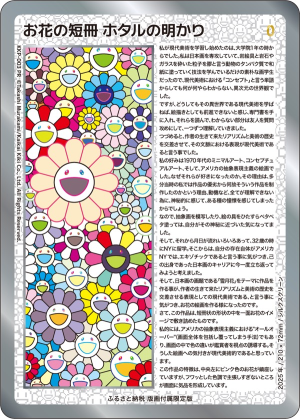
In this series, a strip-like sheet is filled entirely with Flower images. I think of it as an "all-over" painting in the American Abstract Expressionist style, in which the different colors in the painting guide the viewer's gaze. I believe that this kind of awareness of the painting in and of itself is contemporary art.
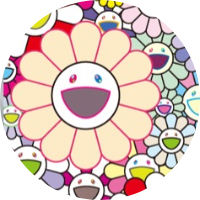
The distinctive feature of this work is the pink Flower positioned slightly left of center. Its soft tones lend a quiet elegance to the composition without overpowering the scene.
|
|
お花の短冊 レインボー
|
|
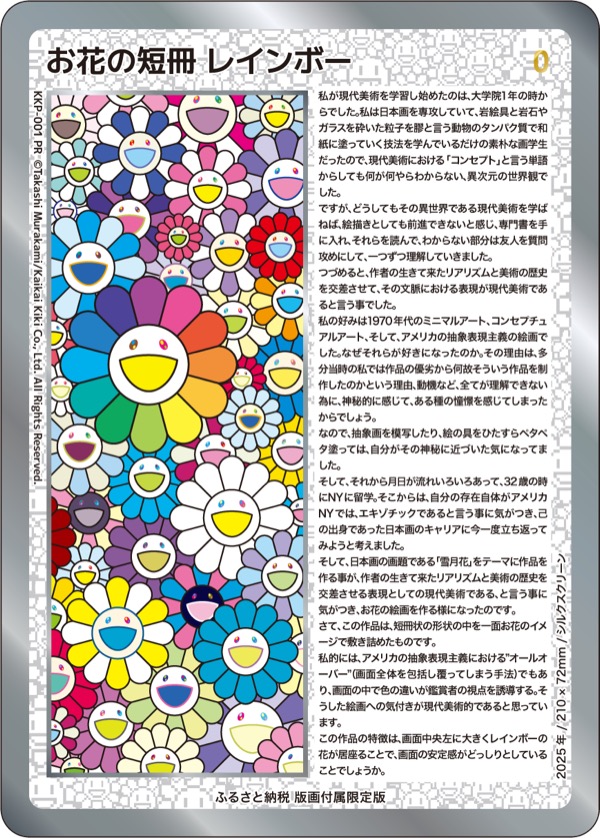
KKP-001 (PR) - I began studying contemporary art during my first year of graduate school. I was a naive art student majoring in Japanese-style painting, Nihonga, simply learning the technique of applying mineral color and crushed rock and glass particles on Japanese paper with nikawa, an animal protein glue. I had no clue what the word "concept” meant in contemporary art, even; it had an entirely different worldview.
I felt, however, that if I didn't learn about this other world that is contemporary art, I wouldn't be able to advance as a painter. So I obtained specialized books, read them, and asked my friends questions about the parts I didn't understand, making sense of things one by one.
What I understood, in short, was that contemporary art is an expression with the intersection of the artist's lived reality and the history of art as its context.
What appealed to me the most were 1970s minimal art, conceptual art, and American abstract expressionist paintings. Why did I like them? Perhaps it was because at the time I couldn't understand anything—which works were superior or inferior, the reasons and motives behind their creation—which made them seem mysterious to me, and I felt a kind of longing for them. So I copied abstract paintings and applied paint on canvas, feeling like I was getting closer to the mystery.
Then, after many years, I went to New York to study when I was 32 years old. There, I realized that my existence itself was exotic in New York, and decided to go back to my roots in the Nihonga career.
I realized that, for me, creating works on the theme of "snow, moon, and flowers," which is often the subject matter of Japanese painting, would constitute contemporary art that crosses the realism of my—the artist’s—life and the history of art. And so I began to create paintings of flowers.
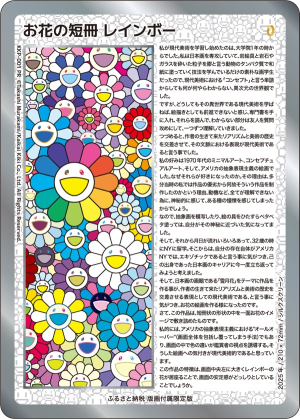
In this series, a strip-like sheet is filled entirely with Flower images. I think of it as an "all-over" painting in the American Abstract Expressionist style, in which the different colors in the painting guide the viewer's gaze. I believe that this kind of awareness of the painting in and of itself is contemporary art.
This work is characterized by a large rainbow Flower positioned just left of center, which gives the painting a strong sense of stability.
|
|
お花の短冊 川床で楽しむ夏の涼
|
|
KKP-002 (PR) - I began studying contemporary art during my first year of graduate school. I was a naive art student majoring in Japanese-style painting, Nihonga, simply learning the technique of applying mineral color and crushed rock and glass particles on Japanese paper with nikawa, an animal protein glue. I had no clue what the word "concept” meant in contemporary art, even; it had an entirely different worldview.
I felt, however, that if I didn't learn about this other world that is contemporary art, I wouldn't be able to advance as a painter. So I obtained specialized books, read them, and asked my friends questions about the parts I didn't understand, making sense of things one by one.
What I understood, in short, was that contemporary art is an expression with the intersection of the artist's lived reality and the history of art as its context.
What appealed to me the most were 1970s minimal art, conceptual art, and American abstract expressionist paintings. Why did I like them? Perhaps it was because at the time I couldn't understand anything—which works were superior or inferior, the reasons and motives behind their creation—which made them seem mysterious to me, and I felt a kind of longing for them. So I copied abstract paintings and applied paint on canvas, feeling like I was getting closer to the mystery.
Then, after many years, I went to New York to study when I was 32 years old. There, I realized that my existence itself was exotic in New York, and decided to go back to my roots in the Nihonga career.
I realized that, for me, creating works on the theme of "snow, moon, and flowers," which is often the subject matter of Japanese painting, would constitute contemporary art that crosses the realism of my—the artist’s—life and the history of art. And so I began to create paintings of flowers.
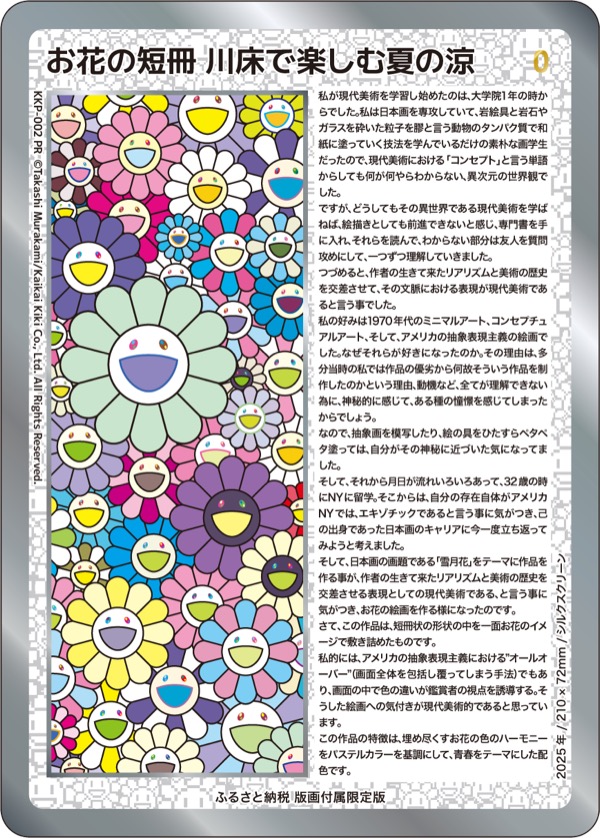
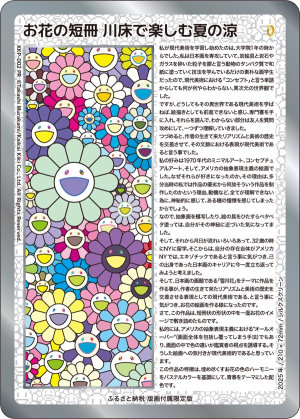
In this series, a strip-like sheet is filled entirely with Flower images. I think of it as an "all-over" painting in the American Abstract Expressionist style, in which the different colors in the painting guide the viewer's gaze. I believe that this kind of awareness of the painting in and of itself is contemporary art.
A defining feature of this work is the harmonious pastel color palette of the densely arranged Flowers, evoking a theme of youth.
|