|
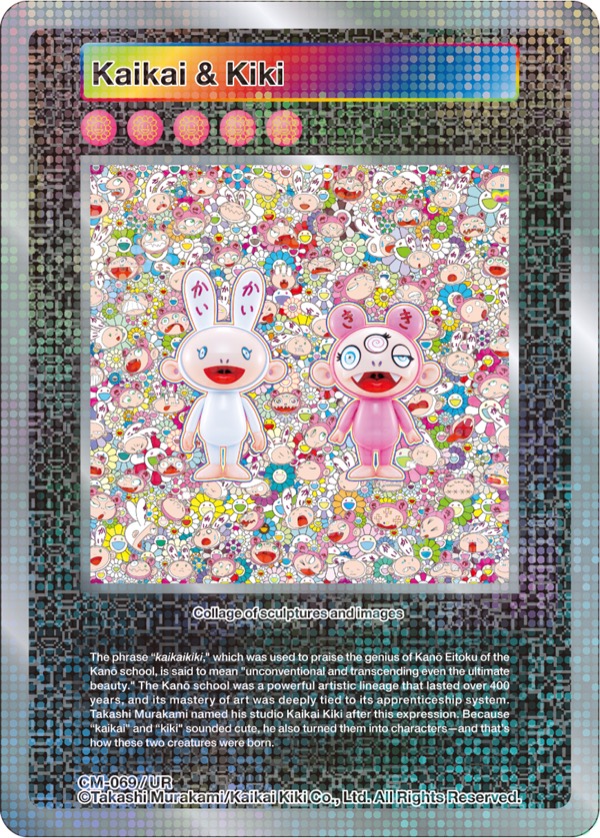
Kaikai & Kiki
|
|
CM-069 (UR) - The phrase “kaikaikiki," which was used to praise the genius of Kanō Eitoku of the Kanō school, is said to mean "unconventional and transcending even the ultimate beauty." The Kanō school was a powerful artistic lineage that lasted over 400 years, and its mastery of art was deeply tied to its apprenticeship system. Takashi Murakami named his studio Kaikai Kiki after this expression. Because “kaikai" and “kiki" sounded cute, he also turned them into characters—and that’s how these two creatures were born.
|
|
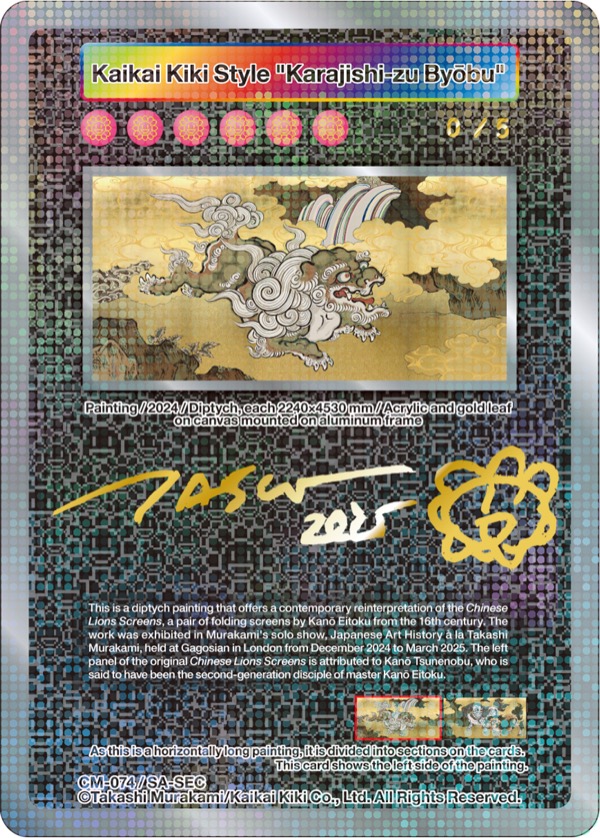
Kaikai Kiki Style "Karajishi-zu Byōbu"
|
|
CM-074 SA-SEC - This is a diptych painting that offers a contemporary reinterpretation of the Chinese Lions Screens, a pair of folding screens by Kanō Eitoku from the 16th century. The work was exhibited in Murakami's solo show, Japanese Art History à la Takashi Murakami, held at Gagosian in London from December 2024 to March 2025. The left panel of the original Chinese Lions Screens is attributed to Kanō Tsunenobu, who is said to have been the second-generation disciple of master Kanō Eitoku.
As this is a horizontally long painting, it is divided into sections on the cards.
This card shows the left side of the painting.
|
|
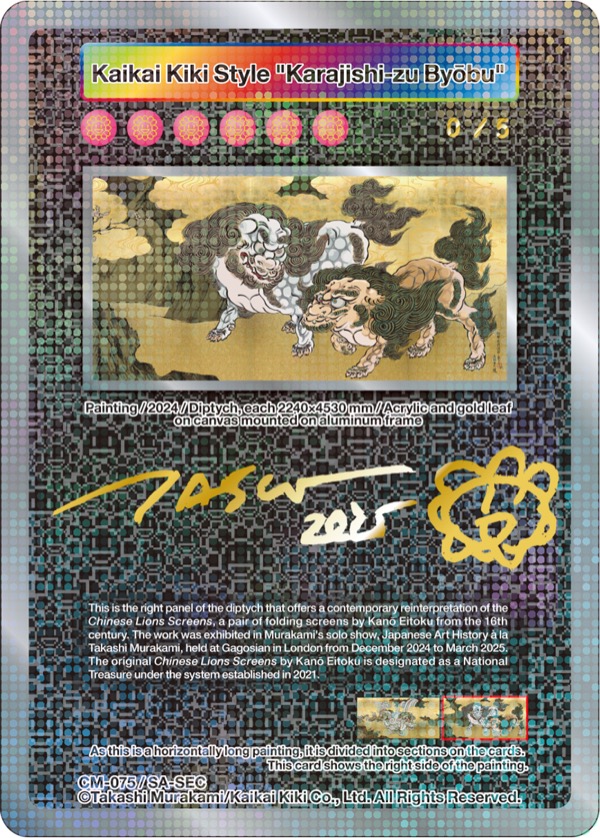
Kaikai Kiki Style "Karajishi-zu Byōbu"
|
|
CM-075 SA-SEC - This is the right panel of the diptych that offers a contemporary reinterpretation of the Chinese Lions Screens, a pair of folding screens by Kanō Eitoku from the 16th century. The work was exhibited in Murakami's solo show, Japanese Art History à la Takashi Murakami, held at Gagosian in London from December 2024 to March 2025. The original Chinese Lions Screens by Kanō Eitoku is designated as a National Treasure under the system established in 2021.
As this is a horizontally long painting, it is divided into sections on the cards.
This card shows the right side of the painting.
|
|
Shōtoku Taishi at Sixteen
|
|
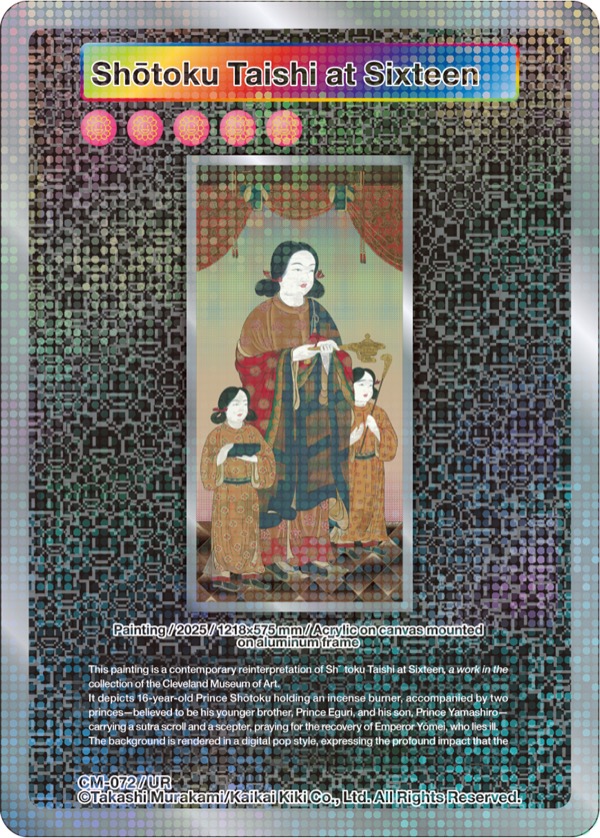
CM-072 (UR) - This painting is a contemporary reinterpretation of Shōtoku Taishi at Sixteen, a work in the collection of the Cleveland Museum of Art.
It depicts 16-year-old Prince Shōtoku holding an incense burner, accompanied by two princes—believed to be his younger brother, Prince Eguri, and his son, Prince Yamashiro—carrying a sutra scroll and a scepter, praying for the recovery of Emperor Yōmei, who lies ill.
The background is rendered in a digital pop style, expressing the profound impact that the encounter with Buddhism had on the Japanese people at the time.
|
|
Yumedono Inspired by the Shōgun Team 2025
|
|
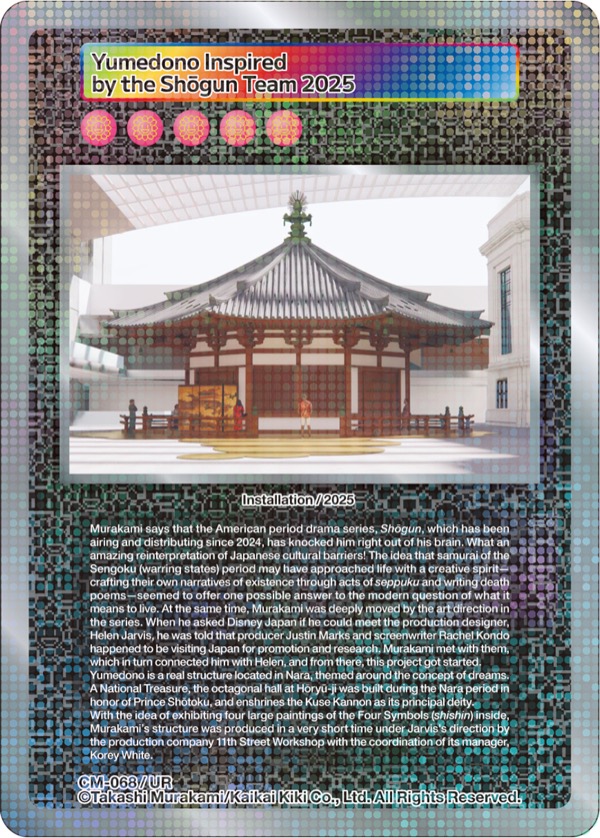
CM-068 (UR) - Murakami says that the American period drama series, Shōgun, which has been airing and distributing since 2024, has knocked him right out of his brain. What an amazing reinterpretation of Japanese cultural barriers! The idea that samurai of the Sengoku (warring states) period may have approached life with a creative spirit—crafting their own narratives of existence through acts of seppuku and writing death poems—seemed to offer one possible answer to the modern question of what it means to live. At the same time, Murakami was deeply moved by the art direction in the series. When he asked Disney Japan if he could meet the production designer, Helen Jarvis, he was told that producer Justin Marks and screenwriter Rachel Kondo happened to be visiting Japan for promotion and research. Murakami met with them, which in turn connected him with Helen, and from there, this project got started.
Yumedono is a real structure located in Nara, themed around the concept of dreams. A National Treasure, the octagonal hall at Hōryū-ji was built during the Nara period in honor of Prince Shōtoku, and enshrines the Kuse Kannon as its principal deity.
With the idea of exhibiting four large paintings of the Four Symbols (shishin) inside, Murakami’s structure was produced in a very short time under Jarvis's direction by the production company 11th Street Workshop with the coordination of its manager, Korey White.
|